

Los Angeles is spending more but getting less. A new mayor won’t fix it


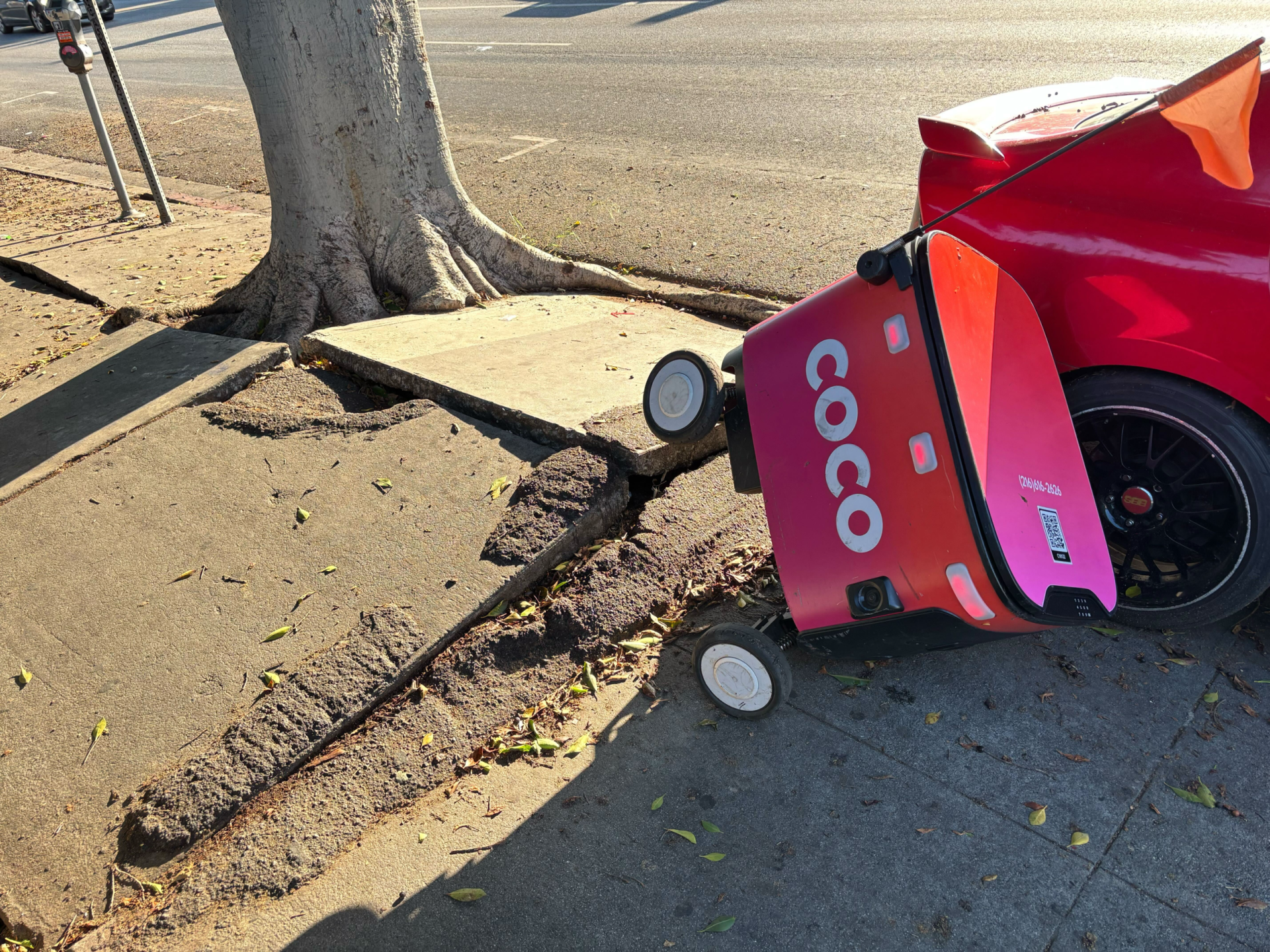
A Coco delivery robot tipped over on a broken sidewalk in LA, highlighting how damaged sidewalks can create obstacles for both people and delivery robots.(Chris Damien / The LA Local)
(This story is produced in partnership with The LA Local.)
From street sweeping to tree trimming, Los Angeles residents are seeing less of the basic services they rely on.
With the mayoral race heating up, candidates are promising to fix the problem. But Los Angeles is spending more and getting less — and whoever wins will inherit a system that limits how much they can actually change.
In five years, Los Angeles’s budget grew 34%. The number of sidewalks it repaired fell 33%.
Residents are feeling the effects in their neighborhoods. In 2021, Los Angeles cut street sweeping from weekly to every other week. In Westlake, a group of volunteers responded by picking up trash the Bureau of Sanitation left behind, said Elaine Alaniz, president of the Westlake North Neighborhood Council.
When asked how she felt about the decline in services, Alaniz hesitated to speak for herself.
“I don’t even want to put feeling [into it]. Let me just tell you by the responses that I’m getting from the community,” she said.
As most Angelenos see, these aren’t isolated complaints. They point to a bigger problem: Los Angeles is struggling to keep up with the work residents expect their city to do.
Eight months without repaving a single stretch of road
In 2025, Los Angeles went more than eight months without fully repaving a single stretch of road.
The pause, first reported by Oren Hadar in the newsletter The Future Is L.A., was prompted in part by Measure HLA. The rule, which went into effect in 2024, requires the city to implement bike, bus and pedestrian improvements whenever it paves a street. But the city is straining to meet those requirements.
In a January 2026 City Council committee meeting, StreetsLA General Manager Keith Mozee said a shortage of trucks and workers had left the city unable to fully repave streets while meeting requirements under Measure HLA and the Americans with Disabilities Act. The federal law requires the city to construct curb ramps as part of street repairs.
But even before Measure HLA took effect, the city had been repairing fewer and fewer streets for nearly a decade.
The slowdown is widespread. In the last four years, the average repair time for potholes went from less than a day to roughly seven days, according to city budget documents.
Since July 1, the Urban Forestry Department has performed 14% fewer tree trimmings per month on average than it did two years ago, according to data compiled by the city controller’s office. The controller’s data only go back two years. Tree removals are down 44% over the same period.
‘LA is not designed to work’
 In five years, LA’s budget grew 34%. The number of sidewalks it repaired fell 33%. (Raisa Zaidi / The LA Local)
Rick Cole, an advisor to Nithya Raman’s mayoral campaign, has spent 40 years working in city governments across Southern California. For Cole, the decline in services is the symptom of a deeper problem. In June, during a farewell speech at City Hall as he stepped down from his role as deputy controller, he told the crowd, “LA is not designed to work.” Decades of ignoring “mind-numbing bureaucracy” have made the city ungovernable, he said. “Beneath the broken sidewalks is a broken system.”
The costs of doing less
The Bureau of Street Lighting’s direct expenses, including salaries, equipment and supplies, have jumped by 56% since 2022. The Department of Transportation’s direct costs have risen 29% over the same period, according to city budget data. Spending trends vary by program. Budgets for parking enforcement and sidewalk repair have each gone up about 15%, while street resurfacing has dropped by roughly 40%.
Employment costs are driving much of the increase. Raises approved in the past three years are expected to add hundreds of millions of dollars to payroll expenses, even as the city controller and budget advocateswarn the increases could deepen the city’s budget deficits.
In 2023, the union representing rank-and-file Los Angeles Police Department employees secured a deal worth roughly $384 million in salary and benefit increases. Although some objected, Bass and others said the raises were necessary to compete with other regional police departments seeking to recruit LAPD officers.
After the LAPD raises were approved, other public employee unions representing more than 33,000 city workers have also pushed for raises. The finalized deals will add hundreds of millions of dollars to the city budget each year, with the annual cost rising to more than $1 billion by the contract’s end in mid-2029, according to a report from the City Administrative Officer.
Cutting city services can end up costing more elsewhere. Deteriorating infrastructure can lead to injuries from potholes, falling tree branches and other hazards, which can result in lawsuits. Payouts from liability claims due to “dangerous conditions” have more than tripled since 2021, costing the city $88 million by 2025, according to the controller’s website.
The city lost $102.9 million because it couldn’t hire 25 people
The city’s Bureau of Street Services, or StreetsLA, has a fleet of 26 pothole repair trucks, but only enough staff to run 12 of them regularly. The staffing shortage has roots that stretch back decades.
Former officials point to the city’s cumbersome hiring process, which the city charter lays out in roughly 14,000 words.
First, the Department of Personnel must create a job classification. It then schedules a civil service exam for applicants. Personnel creates a list of candidates based on the results. That process usually takes more than seven months.
But the exam often has nothing to do with the requirements of the actual job, say former department heads. Frequently, the candidates who wind up on the list lack the experience for the position.
“At least 50% of the time, there is no one on the list you want to hire,” said one former department head. In other cases, the process takes so long that the strongest applicants have taken other jobs.
Several years ago, rising traffic deaths prompted calls for more crossing guards. The Department of Transportation began recruiting candidates, but more than two years passed before it could start hiring. By then, city budget cuts had curtailed the program.
Sometimes the slow hiring process costs the city millions. Over the summer, the city had to give up $102.9 million in state transportation grants because it couldn’t fill 25 positions, despite having two and a half years to do so. Without the staff, the city couldn’t access the money intended for road and sidewalk improvements in Boyle Heights, Wilmington and Skid Row.
The problems are not new. In 2018, then-City Controller Ron Galperin published a report on the city’s hiring process that found it took an average of seven and a half months to hire an employee, causing qualified candidates to drop out in favor of other opportunities.
The Department of Personnel’s slow process has hindered Bass’s effort to increase the Los Angeles Police Department’s force to 9,500 officers, roughly 1,000 more than it has now. “The city’s hiring process was so fundamentally broken,” she told The Los Angeles Times in a recent interview, that promising recruits were kept waiting so long that they gave up.
The city also suffers from its overall structure: It has 41 departments — from airports to the zoo — each with its own budget, staff and priorities. When projects ranging from installing a traffic light to fixing a curb require multiple departments to coordinate.
In 2023, the Department of Transportation launched an effort to increase shade at bus stops, but building a substantial shelter required input from multiple departments. Anything involving electricity requires the Department of Water and Power. Anything that involves breaking concrete requires the Department of Public Works. And complex projects require the Bureau of Engineering.
Instead, the Department of Transportation tried to go it alone. Its experimental prototype, called La Sombrita, was ridiculed, including by The New York Times, for providing a thin strip of shade and no seating. The project went nowhere.
Why LA’s mayor can’t just fix it

As the mayoral race intensifies, both candidates have outlined their positions on the decline in city services.
Neither campaign responded to a list of questions about how they would address these challenges, despite multiple requests. Their problems, however, are reflected in the interviews, debates and social media.
Bass has repeatedly pointed to the city’s first-ever Capital Infrastructure Program, which she launched in October 2024. The effort produced a 112-page report and the city’s first capital plan to coordinate resources around specific programs and projects. The report says it provides the city’s first detailed review of its infrastructure in 30 years and proposes reforms, including a citywide system to prioritize projects and measures to ensure future capital plans are fully funded and staffed in good time.
Raman has also pledged to deliver a capital improvement plan. She has criticized Bass’ plan for focusing on just 29 projects related to the 2028 Olympic and Paralympic Games, though a citywide infrastructure plan is slated for release in December. Two reforms on Raman’s platform, requiring capital infrastructure plans and creating a director of public works position to carry them out — are already on the November ballot as part of Measure LA.
Unlike Bass, Raman’s platform calls for hiring additional managers, including a director of Vision Zero, the city’s failed effort to eliminate traffic deaths, and dedicated chief financial and chief operating officers. Those responsibilities are currently folded into existing positions. She has also promised to fund additional services in some parts of the city, including street sweeping and road repairs, and to reexamine how the city builds curb ramps and repairs sidewalks.
As voters weigh their options, the question isn’t just who has the best plans to fix city services. It’s who can actually get the city to carry them out. Both candidates have offered ways to address the problem, but years of inaction have left Los Angeles with crumbling infrastructure and a backlog of repairs that will only become more expensive the longer the city waits.
How we did it: We examined city budgets going back a decade, as well as performance metrics for specific departments contained in budget documents and from the Los Angeles Controller.
Have questions about our data? Write to us as askus@xtown.la
David Rendon contributed to this report.


