Palisades post-fire rebuilding efforts start to sputter


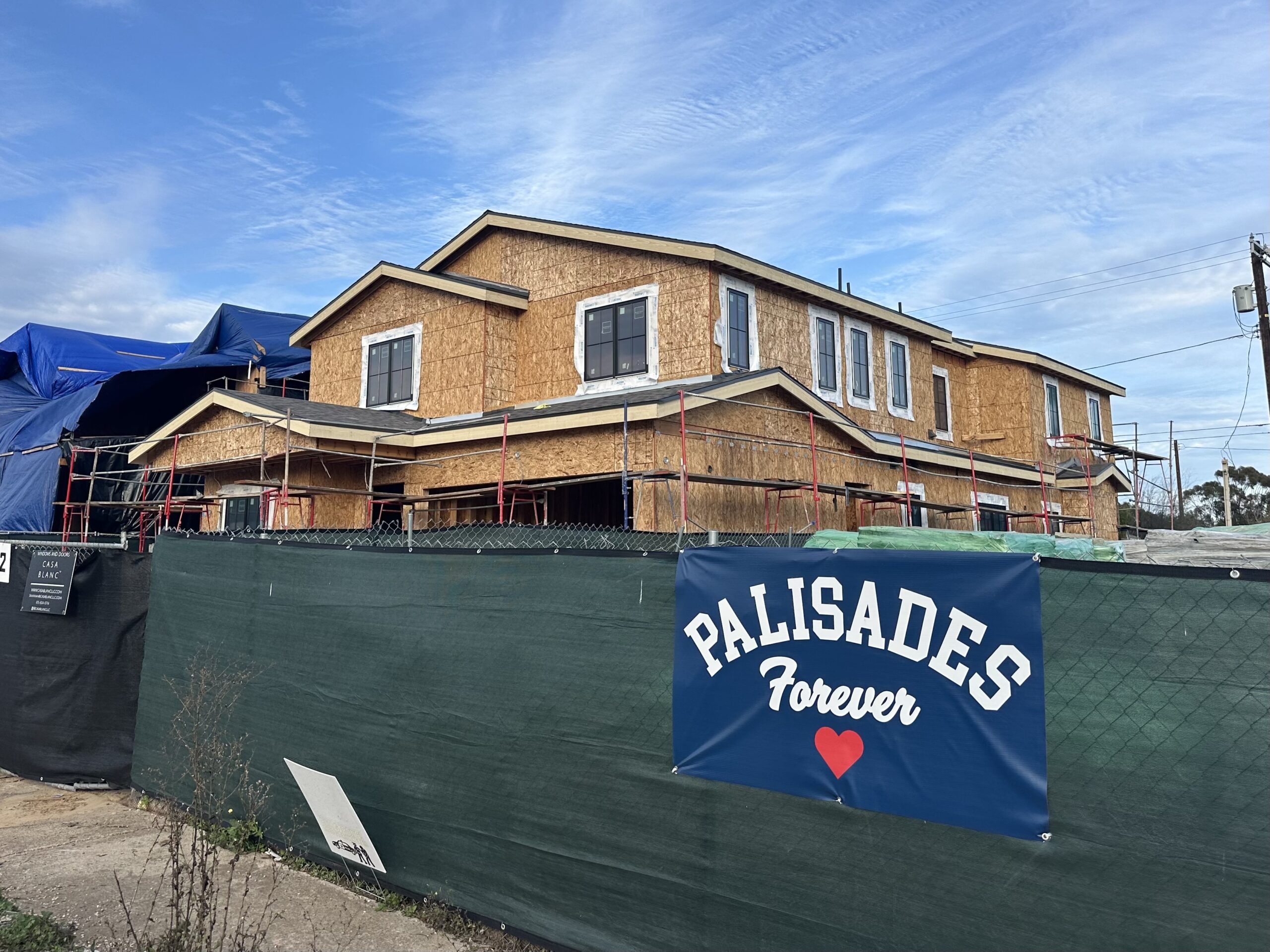
(Photo: Jarrett Carpenter)
One year after the devastating Palisades Fire, the pace of rebuilding has begun to sag, with the last two months of the year showing marked declines in the number of permits issued.
The blaze, which began on Jan. 7, 2025, destroyed nearly 7,000 structures in the area and caused billions in damages. Since then, 3,090 building and electrical permits have been approved in the Pacific Palisades, according to Los Angeles Department of Building and Safety data, far more than any other neighborhood in the city. Of those, 563 were permits for breaking ground on a new building.
The number of permits peaked in October, at 495. In November, the total fell to 356. December had 373 approved permits.
City-issued building and electrical permits are required for any substantial construction, and a slowdown acts like a break on practically all rebuilding efforts. From the earliest days of the fire recovery, Mayor Karen Bass pledged to address the city’s notoriously slow permitting process, which often requires sign-offs from multiple departments that rarely coordinate with one another.
Painful permitting process
Bass issued a series of executive orders that included fee suspensions, a goal for city departments to complete initial reviews of building plans within 30 days and the implementation of eCheck AI Pilot, an artificial intelligence tool that reviews building and zoning plans.
But it’s unclear how effective those measures have been at cutting through the city’s infamous tangle of red tape.
David Shirley, who runs Shirley Construction, lost his home to the blaze. He is working on a dozen fire-resistant rebuilds in the Palisades. He said the city promised to expedite the permitting process, but it has been “painfully slow.”
“We were hoping for some help from the city to make things go quicker and faster, but so far, we haven’t found that to be true,” Shirley said. “We just did one [house] and had to get 16 different clearances for it.”
In a statement to Crosstown, the Department of Building and Safety said the average wait time between submitted application and issued permit as of Jan. 2 is 49 days across all permit types related to the Palisades rebuild. According to a Crosstown analysis, of the 373 building permits issued for the Palisades in December, 42% were in queue for 49 days or longer.
One-stop shop?
One City Hall initiative was intended to set up a one-stop permitting center for residents and business owners to meet with representatives from 10 city departments. However, that also has faced criticism.
“If all of the various departments aren’t represented there and ready to go, the chain breaks under the weakest link, so it doesn’t really change much,” said Mott Smith, a founding board member of the Council of Infill Builders.
Smith is also part of the Project Recovery Plan, a group including the Urban Land Institute Los Angeles, UCLA Ziman Center and USC Lusk Center, that put together a blueprint for rebuilding after the fires. One of the key recommendations was to implement a “self-certification” program for architects and engineers to self-verify that their plans meet building codes.
“The plan check process, which could take many, many months and add tens of thousands of dollars of expenses, isn’t really changing the outcomes in a meaningful way,” Smith said. “A licensed, insured architect and engineer should know the building code well enough to design something that is up to code.”
Bass adopted some of the suggestions in her Emergency Executive Order 6, which established a self-certification pilot program with the goal of bypassing drawn-out department clearances.
David P. Waite, a land-use attorney at Cox, Castle and Nicholson, who is also a member of the Project Recovery Plan team, said the primary permitting hurdle is the approvals needed from over a dozen city departments, including Building and Safety, Planning, Water and Power, and Engineering.
“That kind of coordination still remains a bottleneck from the standpoint of the time that it takes to actually get the clearances.”
Seasonal dip
Decreases in approved permits in November and December are common. A Crosstown analysis of five years of building permit data found the number of permits issued typically drops during those months.
This past December, however, the number of permits issued was especially low. About 7,500 permits were issued across the city of Los Angeles, the lowest count in any month since January 2021. However, the number of applications submitted last month was also low. The monthly average of submitted permits in 2025 was 2,677, but only 637 were submitted in December.
In a statement to Crosstown, the Department of Building and Safety said they “cannot speculate on the reasons for the recent decline in permitting, as the change is not the result of an internal DBS issue or policy.”
Smith pointed to San Diego, the leading city in California housing production per capita, as a blueprint to solving the Palisades’ building bottleneck. He said the city created a software tool for every city department to work off the same set of plans.
“If you’re a [San Diego] applicant, you can see the comments and people in different departments can tell when their comments are in conflict with each other,” Smith said. “Instead of doing what we do in Los Angeles, which is to pretend we have a system like that.”
How we did it: We all building and electrical permits submitted to the city’s Department of Building and Safety, and separated out those in the Pacific Palisades neighborhood.
Have questions about our data or want to ask a question? Write to us as askus@xtown.la.