Los Angeles is living a restaurant resurgence


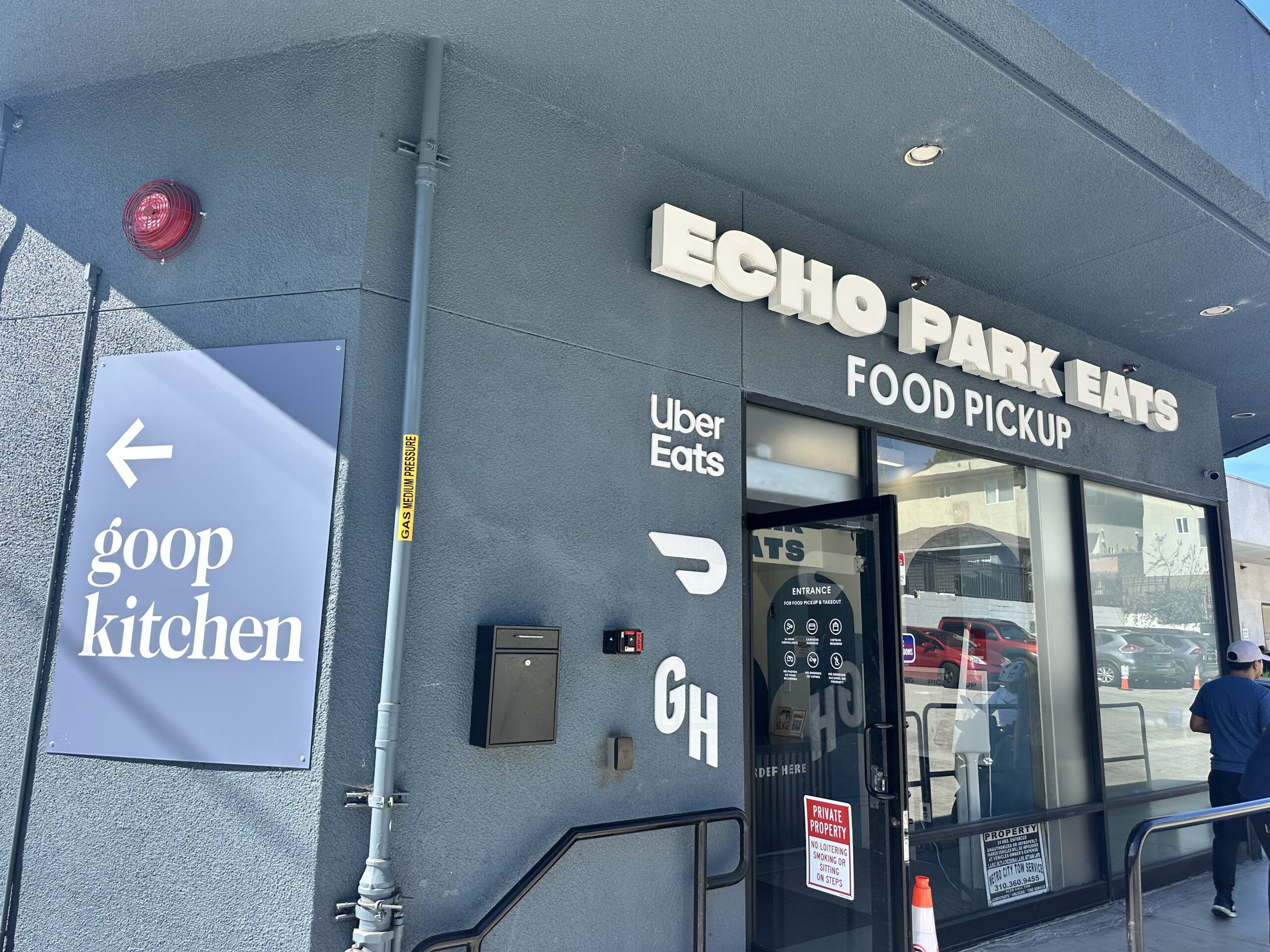
The storefront at Echo Park Eats, which rents ghost kitchens to 40 restaurants. Photo: Jarrett Carpenter
Some of Los Angeles’s most iconic eateries—Papa Cristo’s in Pico-Union, Guerrilla Tacos in Downtown and French eatery TAIX in Echo Park—have closed their doors, prompting hand-wringing about the decline of the city’s rich and diverse food scene.
But those closures obscured a more notable achievement; 758 new restaurants opened last year, surpassing the previous record set in 2024, when 729 restaurants opened.
The split-screen view of dining in Los Angeles is part of a broader transformation that is reshaping the industry nationwide.
The explosion of digital-order services has rewritten the business model for restaurants, which are now operating with less space, reduced staff and tighter margins. Many of the new eateries do much of their business from behind a screen—either through self-service tablets or off delivery apps such as DoorDash, GrubHub and Uber Eats.
So-called “limited-service” restaurants now account for nearly a third of all newly opened establishments. The number of traditional, or full-service, restaurants has also been growing, hitting 539 openings in 2025, and a record-high 587 the year before. If you count the number of coffee, smoothie and snack joints, the numbers rise even further.
Pizza to go
Many of Los Angeles’s restaurateurs are adapting to this burgeoning business model. Last year, Liz Gutierrez turned her pop-up restaurant, Fiorelli Pizza, into a small brick-and-mortar location in Beverly Grove with just a couple of stools at a counter for seating. As she saw restaurants closing their doors, the advantages of the new business model quickly dawned on her.
“This was something that could be operated with minimum labor, it could be way more manageable in terms of fixed costs and expenses, and we could still deliver restaurant-quality [food],” Gutierrez said.
The bevy of new food establishments opening their doors is a lone bright spot in an otherwise bleak economic picture: The total number of new businesses opening in the city is nearly half what it was a decade ago. That is driven in part by some of the same forces, such as Amazon.com, Inc. and other online retailers that put pressure on businesses operating out of traditional storefronts.
But the flourishing restaurant industry has been able to buck that trend so far. While Amazon can deliver clothes and even groceries, it still can’t deliver a fresh pizza or poké bowl.
The QR code will take your order
Linchi Kwok, a hospitality management researcher at Collins College of Hospitality Management at California State Polytechnic University, Pomona, said a lack of interest in working in the hospitality industry, paired with rising labor costs, has pushed restaurant owners to find cost-effective workarounds to run their operations with fewer people.
“Limited-service restaurants don’t have to hire many people to do the work. It saves labor costs, saves space, and saves the service turn-around time. They don’t have to worry about it,” Kwok said.
Restaurants must share a portion of their already slim profit margins—usually between 2-4% in L.A.—with an app service and the driver. To offset that, restaurants have cut down on staff, letting go of waiters, hostesses and dishwashers, many of whom are no longer needed when orders are increasingly being delivered in disposable containers.
Despite the record number of openings, running a restaurant in the city has not gotten any easier. Jot Condie, president and chief executive of the California Restaurant Association, noted that in 2024 taxable restaurant revenue hit $11 billion, which, when adjusted for inflation, is on par with 2012 levels.
“The piece of the pie that each restaurant gets is slimmer.”
Condie also said that the hollowing out of entertainment work, increased presence of Immigration and Customs Enforcement and stricter regulations “are conspiring against the L.A. restaurant scene.”
Condie said that regulations from city hall, such as stricter labor oversight and a proposal for a $30 minimum wage for some workers, are making it even tougher.
“The business environment is bad generally in L.A., but the city council and the mayor seem to be throwing salt in the wound.”
As the number of new restaurant openings has spiked, so have the number of closings reported to the city. However, business closure figures are not as reliable as business opening data, as some establishments close without reporting it to the city. Since 2021, 593 full- and limited-service restaurants have reported closing, compared with 3,148 openings.
Jimmy Chu spent several years working in fine dining, which inspired him to start his own restaurant. He knew it would be expensive. Rather than opening another fine-dining establishment, he opted for a limited-service restaurant where customers could order at the counter, no waiters involved.
Chu quit his job by the end of 2024, and in May 2025, he opened Bomb Hot Dog in Downtown Los Angeles. He estimates that his eatery gets roughly a third of its customers through mobile delivery orders.
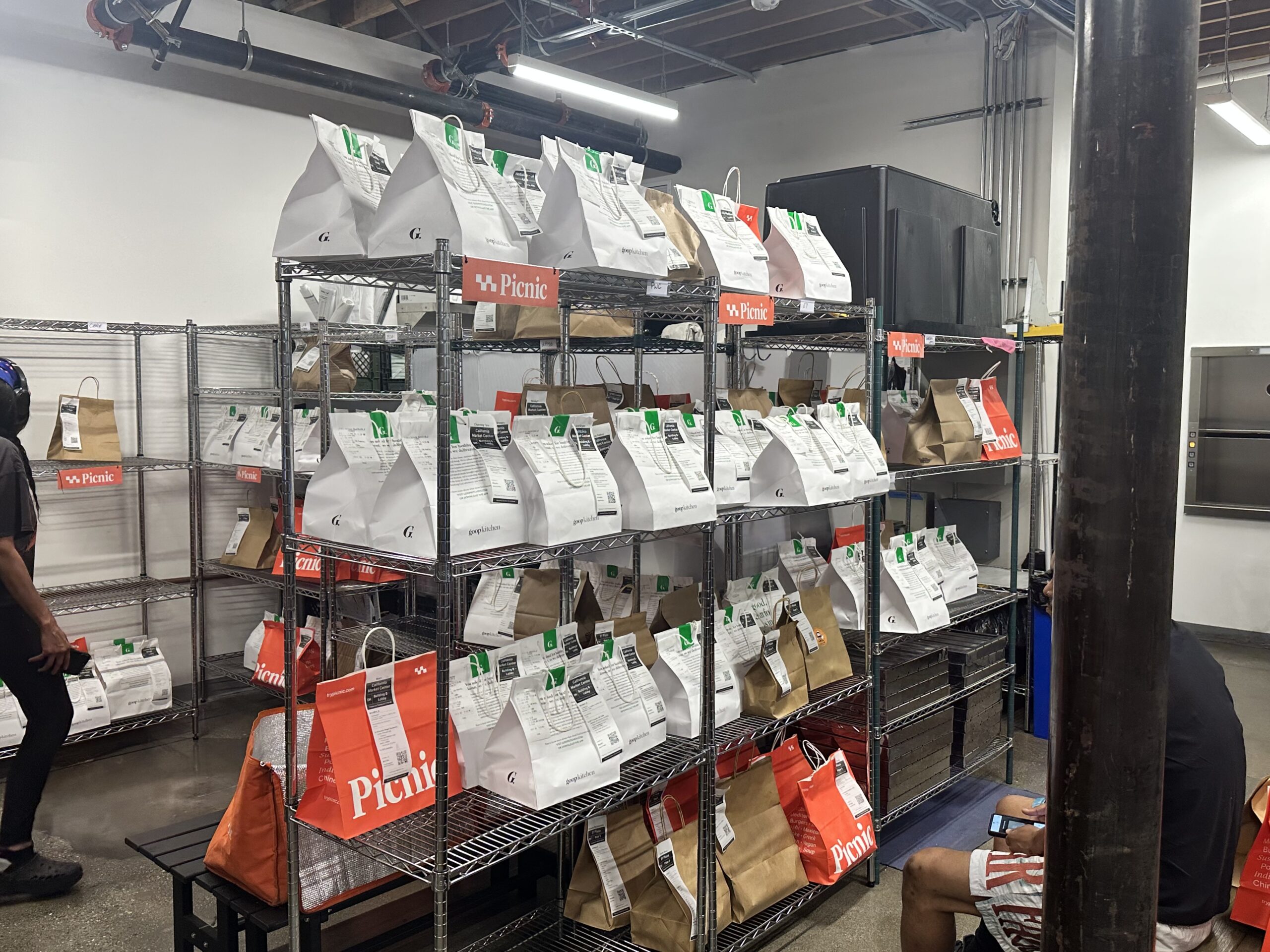
Deliveries are readied for pickup at Echo Park Eats. Photo: Jarrett Carpenter
Ghost kitchens
Ghost kitchens, or private kitchens used exclusively for delivery and takeout, have become a business model of their own. At Beverly Bites, 56 restaurants operate out of one facility serving the densely populated Beverly Hills and Beverlywood neighborhoods, though not all of them are open simultaneously. At Echo Park Eats, 40 restaurants are now within a five minute walk of Dodger Stadium. The Los Angeles Dodgers schedule was hung on the wall inside the facility, so owners can anticipate heavy foot traffic and delivery orders during home games.
Last December, Ali Elreda rented out a space for his Mediterranean-Mexican fusion restaurant, Fatima’s Grill, at Echo Park Eats.
Elreda operates four brick-and-mortar Fatima’s Grill locations, and this is his first time renting a ghost kitchen. He said the decision to start a delivery and takeout location was both a matter of savings and efficiency.
“A lot of people are going the ghost-kitchen route because it’s quicker, it’s faster,” Elreda said. “You avoid a lot of overhead and foot traffic and having to find staff these days with the expensive economy out there is kind of tough.”
With ghost kitchen facilities, business owners also no longer have to compete with each other to find prime real estate in Los Angeles.
“You don’t have to do that research where you’ve got to find the right location. It’s just right there waiting for you,” Elreda said.
How we did it: We examined more than 15 years of business license data reported to the Los Angeles Office of Finance.
Have questions about our data or want to ask us something? Write to use at askus@xtown.la