How ADUs became a major source of new housing in Los Angeles


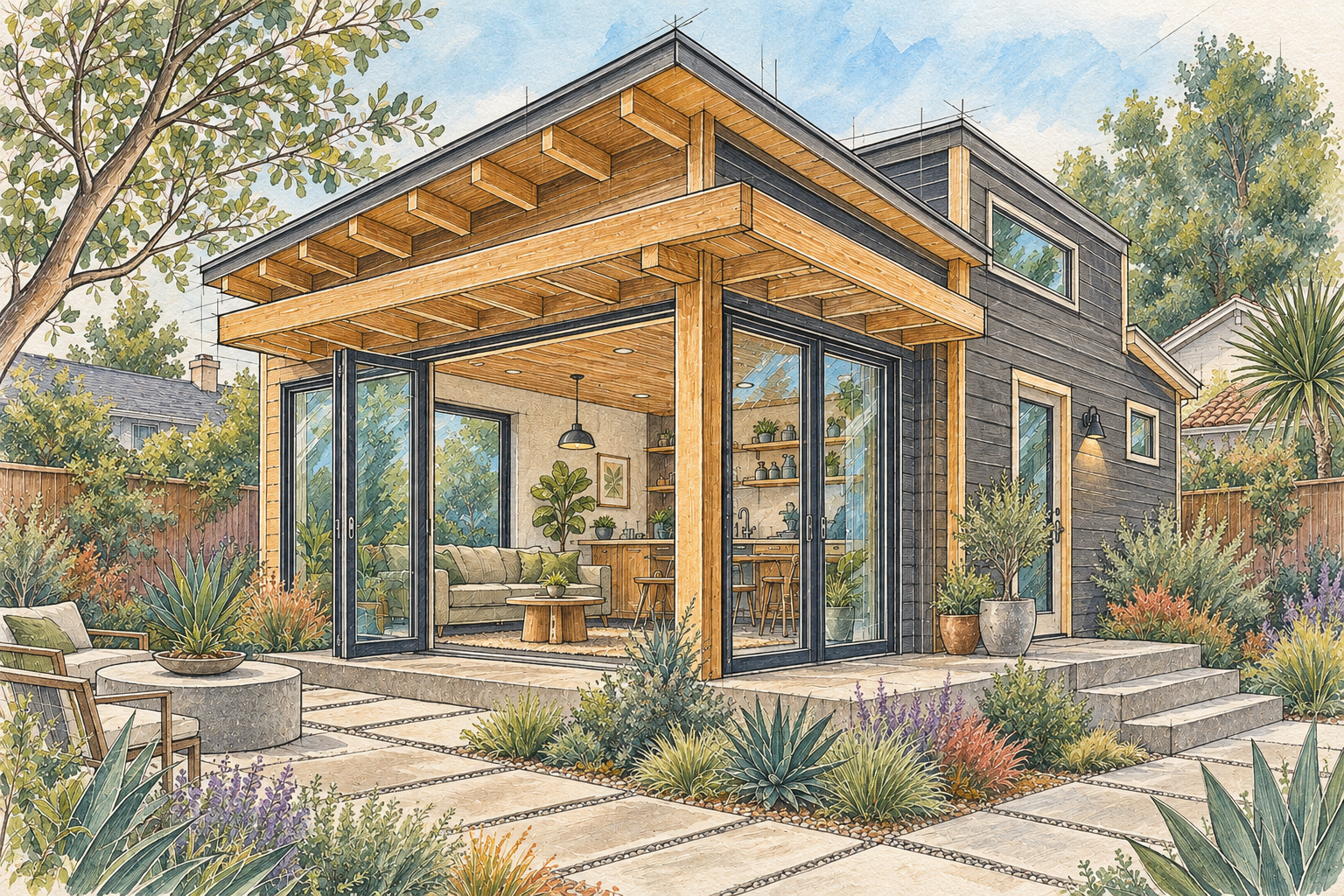
(Architectural rendering created with generative AI)
When Oren Harel first converted the garage in his Encino home into a 451-square-foot accessory dwelling unit, he wasn’t thinking about solving Los Angeles’s chronic housing shortage. He was calculating how the $2,300 monthly rent and boost to the value of his four-bedroom house could improve his financial picture.
“I know the potential income would be able to make back that investment within a few years, and then start creating a profit,” he said.
ADUs are self-contained residential units with their own kitchens and bathrooms, located on the same lot as the primary residence. In 2017, the first year a state law that normalized them took effect, only 1,659 were permitted. Last year, there were 7,321 permitted ADUs. In 2025, ADUs almost supplanted apartments as the largest source of new housing in the city. This year, however, there are early signs of a surge in permits for new apartments.
The bill that legalized ADUs
The runaway success of ADUs is a surprise even to the state legislator who authored one of the laws that made them legal, Senate Bill 1069. “I expected it might be 20% of the permits” for new housing, said former California state Senator Bob Wieckowski. “I don’t know if I expected it would have the continuing strength that it has.”
Before 2016, a thicket of local regulations made it exceedingly difficult to obtain an occupancy permit for a converted garage. “Cities would charge you $80,000 for the honor of building an ADU before you pay one dollar for a two-by-four,” said Wieckowski. “It just got my blood boiling.”
One thing the bill did was alter the narrative around conversions. “We changed the definitions,” said Wieckowski. “It was no longer mother-in-law units, second units, all this stuff. It was an accessory dwelling unit. It was accessory to your house, which meant, by law, you had a right to build something.”
SB1069 created a streamlined process. Unlike apartment projects, ADU projects couldn’t be blocked by local neighborhood groups. The bill prohibited cities from requiring additional parking spaces for ADUs and helped reduce homeowners’ costs by eliminating the requirement for separate utility connections. Assembly Bill 2299, passed on the same day in 2016, significantly restricted a local government’s ability to block ADU construction.
Previously, those obscure local ordinances had impeded homeowners from obtaining ADU permits. “It was such a fatal flaw,” said Jane Blumenfeld, former deputy director in the Los Angeles city planning department and researcher who helped draft AB2299. “It’s like two sentences in the middle of a 2,000-page code.”
A boom no one expected
When the red tape melted away, the business began to boom. Between 2003 and March 2016, there were 644 projects with ADU permits in the city of Los Angeles, only 404 of which received a certificate of occupancy. Within five years of the new regulations, there were more than 7,000 units permitted in Los Angeles, many in neighborhoods that were normally closed off to building new apartments.
“Six years ago, the thought was like, ‘Oh, my gosh, you’re doing ADU?’” Los Angeles contractor Billy Snow said. “Now everyone’s doing ADU. It’s almost like chewing gum.”
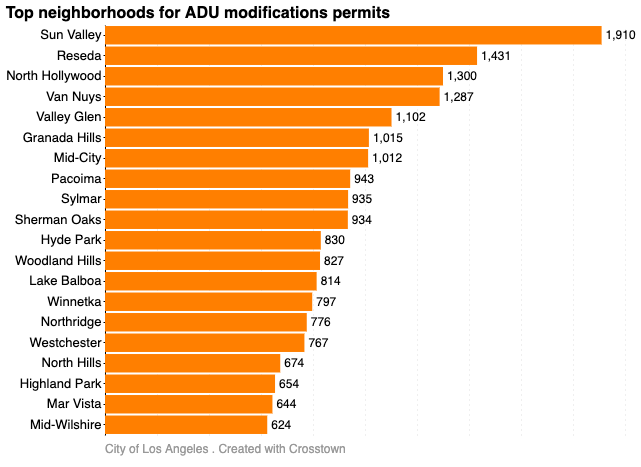
Although backyard homes add units at a slower pace, the streamlined process and faster construction make them much easier than building apartment units. In Los Angeles, the average time from permit to completed ADU construction is 434 days, less than half that of a multifamily project.
Apartment building slowdown
Still, these backyard homes were never intended to be the city’s go-to solution for its housing woes. One of the reasons they have come close to eclipsing all other forms of housing is the city’s failure in permitting more apartment units. Last year, Los Angeles permitted 7,892 units, down 35% from 2019, despite numerous additional funding measures that have channeled billions toward construction of affordable apartments. Permitting does appear to be picking up this year.
Despite low vacancy rates and high demand, investors are reluctant to spend on multifamily projects due to policy uncertainties and tenant-protection laws. A levy on real estate sales over $5 million, known as the “mansion tax,” has further discouraged developers from initiating projects.
“I know developers who have been developing for decades that are leaving the industry,” said Shawn Mahdavian, who runs a real estate consulting firm. “We went from designing 20 to 30 buildings per year to doing two in a good year.”
Building apartment blocks can take years to clear a tangle of regulations and financing requirements. ADUs, on the other hand, can sidestep so many of those hurdles. In most cases, they are not subject to California rent control laws. Los Angeles rent stabilization laws exempt most newly constructed attached and detached ADUs.
“An ADU is probably what’s going to carry the market for the next couple of years, until something changes,” Mahdavian said.
One of the most attractive elements of ADUs for the city of Los Angeles is that it is adding more housing with little public investment. “Basically, these were financed 100% by homeowners, one by one by one,” said Blumenfeld, now a senior fellow at UCLA’s CityLab.
Quick property value boost
The total cost of an ADU often ranges from $75,000 to $350,000, depending on the type of unit, according to a 2023 report from the Los Angeles Housing Department. In 2024, ADUs in the city of Los Angeles accounted for over a fifth of all ADUs permitted in the state, according to data from California Department of Housing and Community Development.
The city has experimented with using ADUs to solve some of its most intractable housing problems. In 2018, with a $1 million grant from Bloomberg Philanthropies, the city launched the L.A. ADU Accelerator Program to match ADU owners with the elderly in need of affordable housing. A year later, the non-profit urban design agency LA Más launched a pilot incentive program, The Backyard Homes Project, aimed at increasing the city’s affordable housing supply by creating ADUs for rent. The project, eventually supported by around 12 ADUs, provided homeowners with resources from financing to construction of the rental unit, in exchange for a more than five-year commitment to rent the ADU to low-income tenants through Section 8.
However, what ADUs really unleashed was something much more basic: a quick and cheap way to both increase revenue and property values. The median appraised value of properties with ADUs in the state was $349,000 higher than that of comparable properties without them, according to 2025 Federal Housing Finance Agency data. Annualized value growth for those properties was also 2 percentage points higher than those without a backyard home.
Matt Schodorf, a Highland Park resident and co-owner of the local Cafė de Leche, was one of the first to apply for an ADU permit after the new laws went into effect in January 2017. With two children and a need for more space at their two-bedroom home, he converted his 160-square-foot garage into an ADU.
Though it has served as a guest house and occasional work studio, it will soon be the living space for their daughter who recently graduated college, helping her save on rent. “When she’s not in the house, she’ll have her own little independent spot, so it worked out really well for us.”
How we did it: We examined more than a decade of building-permit data in Los Angeles to track ADUs, apartments and single-family homes.
How questions about our data? Write to us at askus@xtown.la